

High-traffic loading bays take a beating that most people outside of facility management never see. Trailers dock and depart around the clock, forklifts move through openings hundreds of times a day, and every one of those cycles is a chance for impact damage, air loss, or a security gap. For warehouses, distribution centres, and food-grade or pharmaceutical facilities across the GTA, the door on that bay is not a minor fixture. It is the working boundary between a controlled interior and everything outside it. Reinforced drive-in doors Toronto operations rely on are built to hold that boundary under constant strain, and choosing the right one has a direct effect on safety, energy costs, and how smoothly a bay runs.
Why High-Traffic Bays Wear Down Faster
A loading dock is one of the largest openings to the outdoors in any commercial building, and it is also one of the busiest. Doors that are raised and lowered continuously, sometimes without pause across a full shift, face wear that a standard overhead door was never designed to absorb. Forklift traffic, weather exposure, and the sheer number of daily cycles add up quickly. When maintenance gets pushed aside, small issues turn into breakdowns, and a stuck or damaged bay door can halt an entire receiving operation.
Reinforced construction changes that equation. A foam-injected core does more than insulate. Bonding the inner and outer steel faces into a single rigid panel adds structural stiffness, which makes the door less prone to warping, flexing, and wind-load damage over time. Doors engineered with impact resistance in mind can take moderate to severe hits and return to smooth operation rather than failing outright, which keeps a high-traffic bay moving instead of waiting on repairs.
Sealing, Security, and Energy Control
Because a dock opening is so large, it is frequently the single biggest source of lost heated or cooled air in a warehouse. An uninsulated or poorly sealed door quietly drains climate control every day the bay is in use. Insulated sectional doors carry meaningful R-values, with common commercial models rated around 14.8, and higher-performance lines reaching considerably further. That insulation keeps interior surfaces closer to room temperature, which also cuts the condensation that damages inventory, creates slip hazards, and accelerates rust on the door itself.
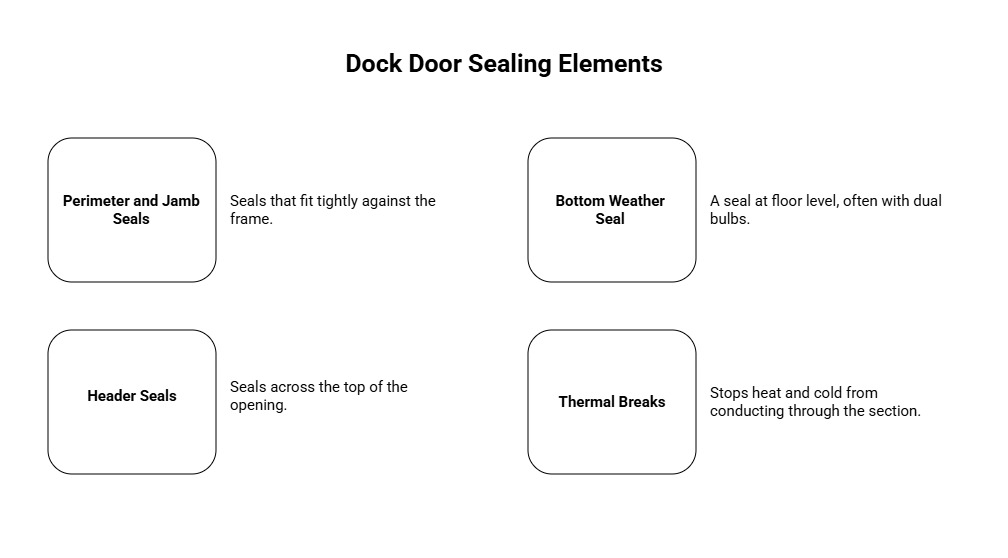
Sealing matters just as much as the panel. Well-built dock doors combine several elements to hold the line against air and water infiltration:
- Perimeter and jamb seals that fit tightly against the frame
- A bottom weather seal, often with dual bulbs, to close the gap at floor level
- Header seals across the top of the opening
- Thermal breaks that stop heat and cold from conducting through the section
Security is the other half of the picture. A reinforced door with a solid locking mechanism holds up against both impact and forced entry, which matters for facilities storing high-value or regulated goods. For bays cycled constantly throughout the day, pairing a reinforced door with a high-speed unit can reduce the temptation to simply leave the door open, closing a common and costly energy gap.
Matching the Door to the Operation
No two loading bays run the same way. Cold storage, food processing, pharmaceutical handling, and general distribution each place different demands on a door in terms of insulation, cycle frequency, and clearance. Sectional doors that travel vertically and stack overhead are often the practical choice, since they clear the opening without crowding dock levellers or trailer restraints. The right specification depends on opening size, how often the door cycles, the climate control the space requires, and the level of security the goods demand. Getting that match right at the outset is what keeps repair and downtime costs low over the life of the door.
For facilities across the Greater Toronto Area, NEX Industrial supplies, installs, and services drive-in sectional doors built for exactly these conditions, with high insulation ratings, tight-sealing construction, and springless designs that reduce maintenance over the long run. Backing that with scheduled inspections and 24/7 emergency service means a bay that stays secure, sealed, and running, which is what a high-traffic operation needs from the door it depends on most.