

Break-ins across Toronto and surrounding cities rarely happen because a business owner was careless. They happened because the wrong barrier was standing between the stock room and the sidewalk at 2 a.m. That is where rolling grill security in GTA retailers starts to pay for itself, quietly cutting the financial damage of forced entry long before a thief ever gets near the register. For storefronts from Mississauga to Markham, the right grill is less about looking tough and more about shrinking loss numbers on the year-end report.
The Real Cost of a Single Break-In
Most owners underestimate what one smashed storefront actually costs. Replacing a glass facade in downtown Toronto can run four to six thousand dollars before anyone talks about stolen merchandise. Add emergency board-up fees, a deductible, lost trading days, higher renewal premiums, and the quiet cost of customers who notice the plywood and walk to a competitor.
Rolling Grills Outperform Standard Alarms Alone
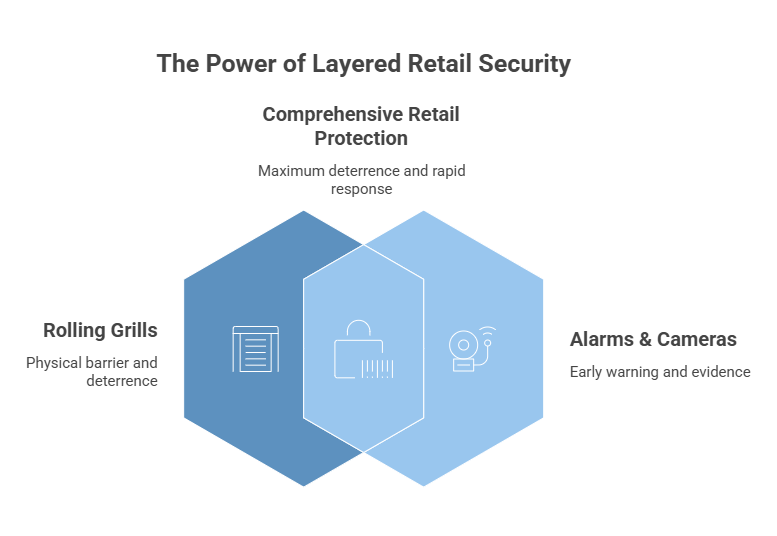
Alarms have their place, but they respond after someone has already tried to get in. A rolling grill changes that equation by putting a physical barrier in front of the opening before a break-in can move past the glass. In many GTA retail corridors, theft happens fast. Someone tests the storefront, looks for a weak point, and tries to be out before anyone nearby reacts. When a grill adds time, noise, and resistance, that quick entry becomes a much riskier attempt. In real terms, that often means the person gives up and moves on. When you combine the grill with cameras and an alarm, your store is no longer relying on one layer of protection. That matters to insurers, and it matters even more when you are trying to avoid repair bills, stolen inventory, and lost business hours.
Retailers across the GTA keep choosing rolling grills for a few practical reasons:
- They protect the storefront without hiding your merchandise from view after closing
- Their finishes stand up well to winter salt, slush, and changing weather
- Motorized models help staff open quickly during early morning routines
- The compact design works well in narrow storefronts where every inch matters
- Custom sizing makes them a good fit for older retail spaces with irregular openings
Matching the Grill to the Risk
Your retail space faces a unique set of risks. A high-end jewelry counter in North York does not have the same late-night foot traffic as a streetwear shop on Queen West, so you need a physical barrier that matches your exact reality. Perforated steel panels work well when you want window shoppers to still see your displays at midnight. That visibility also gives patrol officers a clear view across your sales floor. If you manage a cannabis dispensary or a pharmacy, hiding your inventory is usually part of your security mandate. Solid slat models block out prying eyes entirely. Up in Vaughan or out in Brampton, larger brick-and-mortar retailers frequently choose insulated versions to block loading dock noise and keep winter heating costs under control.
You also have to think about how your team interacts with the door every morning. A manual pull-down makes sense if you only open and close once a day. If you operate a busy multi-tenant plaza or a constantly running convenience site, automation changes the routine. Motorized units operated by a fob or a wall switch save your staff time and physical strain. Taking the human error out of your closing checklist prevents problems before they start.
Choosing the right grill is only part of the decision. Getting it installed correctly into an older Toronto building is where things get technical. Masonry that has been through decades of freeze-thaw cycles does not always anchor the way a newer concrete wall would. Tracks need to be plumb and square, especially in buildings that have shifted over time. If a motor is going into the mix, the electrical panel has to support it cleanly. These are not jobs where cutting corners saves money. A grill that binds, sticks, or fails to close on a cold February night is a liability, not a security measure, and it tends to give owners a false sense of protection while the real risk stays wide open.
Keeping the unit in good shape over the long run comes down to a simple service rhythm. Lubrication before the first hard frost, a check of the bottom bar and lock hardware each spring, and a full inspection every year or two will carry a quality rolling grill well past the fifteen-year mark. Most failures that show up in winter started as small issues that went unnoticed through the summer.
Protecting your store is not a one-time decision. It is a series of small, practical choices that add up over time, and the retailers who see the lowest loss numbers are usually the ones who made those choices before something went wrong. A rolling grill will not solve every security problem your location faces, but it removes one of the most common and costly ones. For most GTA business owners, the math is straightforward. The installation cost is fixed. The protection runs for years. And the first time a would-be thief sizes up your storefront, sees what is in front of them, and keeps walking, the investment has already started working in your favour.
If you are ready to explore options for rolling grill security in GTA for your space, the team at Nex Industrial works with retailers across the GTA to spec, supply, and install rolling grilles that fit the building, the budget, and the business.